
Setting the Scene, Checking the Numbers, Asking the Right Question
You ever walk into a job site and feel the air hum before the switch flips? The crew just swapped in a topcon solar cell field, and the inverter tech is grinning like payday. Data says mass lines can push 23–24% efficiency now, with lab peaks above 26%. That’s not hype—that’s measurable lift in yield and uptime. But here’s the rub: are we comparing like for like, or just chasing shiny specs?
Picture a school rooftop in summer heat, dust in the wind, and a tight O&M budget. The promise is better current at dawn and dusk, fewer hotspots, and less mismatch. Cool. Yet if the line can’t hold uniform passivation or the field install fights shade, that gain can melt away. So the question lands: how do we stack TOPCon against the older playbooks without getting played ourselves (real talk)? We need a fair, clean comparison—and a plan to measure what matters. Let’s break it down and keep it moving.
The Deeper Problem: Why Old Lines Trip Over New Demands
What’s actually breaking in the flow?
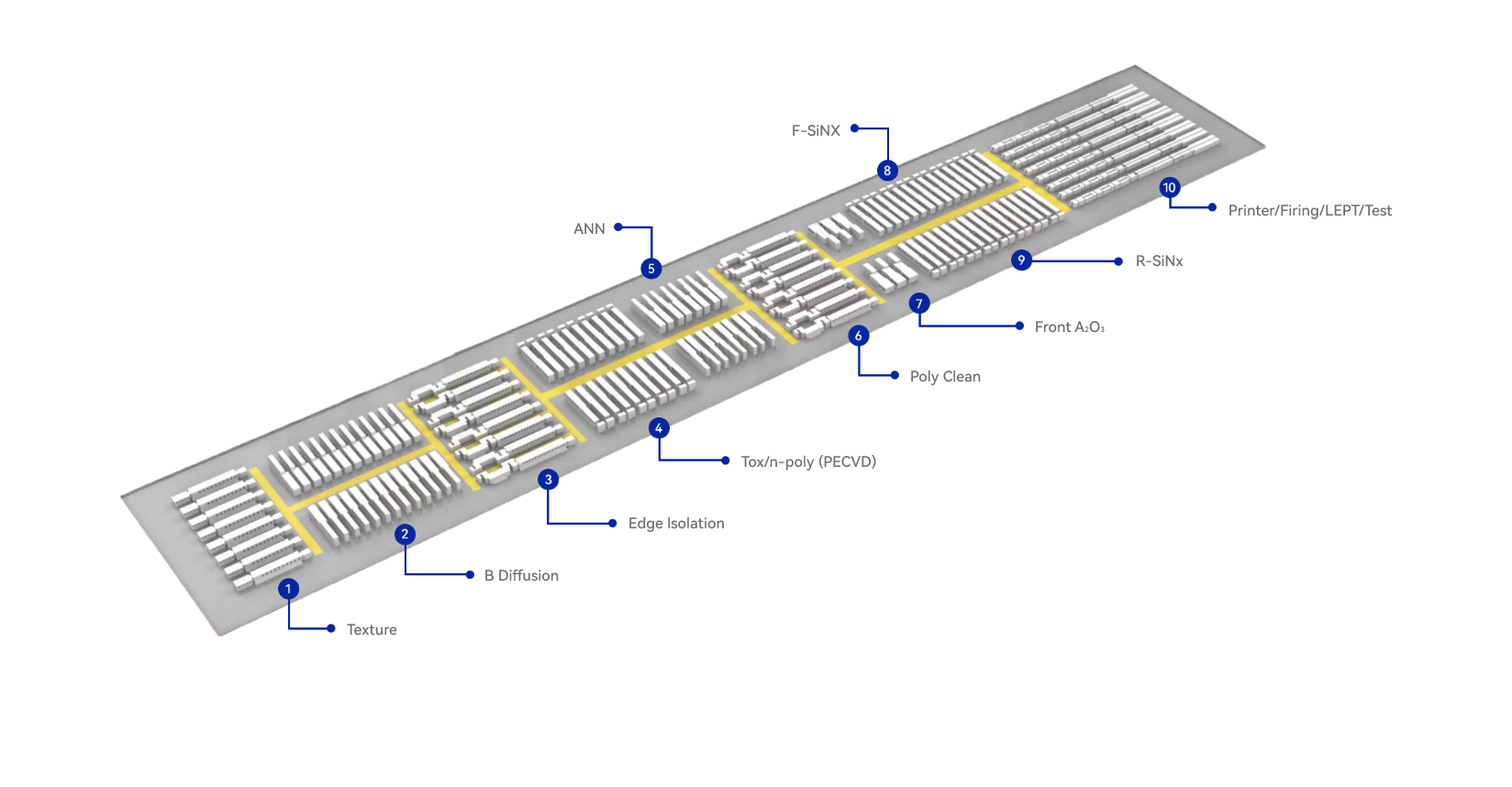
Start with the topcon solar cell manufacturing process. It hinges on a thin tunnel oxide, a doped poly‑Si layer, and stable passivated contacts. Legacy PERC flows weren’t tuned for that. They struggle with tight thermal budgets, uneven anneal profiles, and drift in sheet resistance. Look, it’s simpler than you think: if the tunnel oxide gets too thick or rough, carriers face barriers; too thin, and recombination jumps. Either way, you lose. And if your PECVD tools can’t keep uniformity across a big batch, the median cell looks fine, but tails get ugly—funny how that works, right?
Hidden pain points stack up. Paste choice and metallization can clip current density if contact resistivity spikes. Inline metrology misses micro‑defects at the wafer edge; later, those become hotspots in the field. Bifacial modules promise gains, but mismatch grows when rear-side response varies lot to lot. Even the power converters see the ripple: trackers chase unstable MPP under partial shade when carrier lifetime isn’t stable. The old answer—“add more bins”—just pushes the problem downstream. Better is upstream control of film stress, hydrogenation, and dopant activation. Otherwise, cost per watt looks fine on paper, while LCOE creeps the wrong way.
Comparative Insight: New Principles, Real Choices
What’s Next
Here’s the forward look. TOPCon’s edge isn’t just lab efficiency; it’s how the physics scales when the line is honest. The tunnel oxide blocks recombination while the poly‑Si provides a low‑resistance path—clean. New toolsets enforce tighter thermal windows and smarter feedback loops. Think multi‑zone annealing, wafer-level reflectometry, and closed‑loop sheet‑resistance control. When those are tied to the same disciplined topcon solar cell manufacturing process, you get fewer outliers, better bifaciality, and calmer power curves under real sky. Different sky conditions, same calm curve—that’s value.

Case in point: a utility site swapped a mid‑tier PERC line for a compact TOPCon flow with in‑situ metrology. Yield rose 2.1%, field PR nudged up 0.9 points, and clipping dropped on hot days because series resistance came down. Not magic—discipline. And the lesson sticks: when the process watches itself (and flags drift fast), installers stop over‑engineering racking and wiring to hide variability. Less metal, fewer callbacks, more bankable energy—period. Advisory close-out, so you can choose well: 1) Process capability, not just nameplate—can the line hold tunnel‑oxide thickness and passivated contact uniformity over time? 2) Variance control—do you have real-time metrology for PECVD and anneal, plus a plan for paste/contact resistivity audits? 3) Field stability—does the module keep MPP steady under shade, heat, and dust, or does it hunt? Answer those with data, and you’ll know which path wins. For folks mapping the next plant or retrofit, the comparison gets simple—and the decision gets bold. See who’s building with intent at LEAD.