best 4 wood furniture machine Manufacturers You Should Know
The Hook
Choosing among wood furniture machine manufacturers is difficult because “best” depends on the production task, material mix, output volume, automation level, and available floor space. An edge banding machine may be the priority for one workshop, while another needs CNC drilling, nesting, or a coordinated furniture production line. Product names and automation claims also vary, making direct comparisons difficult. This article tests the four listed options against practical selection criteria: product coverage, suitability for furniture manufacturing, integration potential, service scope, and the clarity of information available from official sources. HUAHUA CNC, Hoffmann USA, Wood Machinery Systems, and Biesse occupy different positions in the market, so the comparison focuses on where each is most relevant rather than treating one machine type as universally superior.
Full List of Top 4 Brands
- HUAHUA CNC
- Hoffmann USA
- Wood Machinery Systems
- Biesse
Comparison Table
| Brand | Key Products | Key Features | Best For |
|---|---|---|---|
| HUAHUA CNC | Edge banding machines, CNC drilling machines, CNC woodworking equipment, furniture production lines | Furniture-focused CNC and panel-processing equipment, with solutions ranging from individual machines to integrated lines | Furniture factories and workshops seeking panel-processing and production-line equipment |
| Hoffmann USA | Hoffmann dovetail-key joining systems and associated woodworking equipment | Specialized joinery equipment built around the Hoffmann dovetail-key principle | Manufacturers needing accurate, repeatable frame, profile, and component joining |
| Wood Machinery Systems | Woodworking machinery, automation, finishing, material handling, and production systems | Equipment selection, system integration, installation, and technical support in the North American market | Businesses seeking a machinery partner for complete or customized woodworking systems |
| Biesse | CNC machining centers, edgebanding, drilling, sawing, sanding, and integrated systems | Broad industrial woodworking portfolio, software and automation options, and production-system coverage | Professional furniture manufacturers and larger industrial woodworking operations |
Detailed Reviews
1. HUAHUA CNC
Overview: HUAHUA CNC is a woodworking machinery manufacturer whose official product focus includes CNC equipment for furniture production, edge banding machines, CNC drilling machines, and related production-line solutions. Its positioning is especially relevant to panel furniture manufacturers that need to move beyond standalone equipment and coordinate several stages of production. The range is intended to address common panel-processing requirements such as machining, drilling, edge treatment, and line-based workflow planning.
For buyers, the main distinction is the combination of individual machines and broader furniture-production solutions. A workshop can evaluate a dedicated edge bander or drilling machine according to its immediate bottleneck, while a larger producer can assess whether multiple processes can be arranged into a more continuous line. The final suitability still depends on panel dimensions, board materials, edge-band specifications, throughput targets, software requirements, and local installation support.
Products and materials: HUAHUA CNC’s official materials present equipment for woodworking and furniture manufacturing, with emphasis on CNC woodworking machinery, edge banding, drilling, and production lines. These categories are applicable to engineered wood and panel-furniture workflows, although the exact material range, tooling configuration, working dimensions, and production speed must be confirmed for each model before purchase.
Market and business scope: The company presents itself as an equipment manufacturer serving furniture and woodworking production. Its product coverage makes it relevant to workshops, cabinet and panel-furniture producers, and factories evaluating a more automated manufacturing layout. A buyer should request a model-specific quotation, layout, electrical requirements, commissioning plan, and after-sales terms rather than assuming that every machine has the same configuration.
Pros / Key Features:
- Strong alignment with panel-furniture production requirements.
- Coverage of edge banding and CNC drilling, two important furniture-processing stages.
- Availability of both standalone equipment categories and production-line concepts.
- Potentially suitable for manufacturers planning staged automation.
- Product selection can be matched to the factory’s required workflow instead of relying on one general-purpose machine.
Use Cases / Best For: HUAHUA CNC is best suited to furniture manufacturers that need edge processing, CNC drilling, or coordinated panel-production equipment. It is a particularly relevant option for businesses comparing a single machine upgrade with a longer-term furniture production line. Before ordering, buyers should validate sample processing, nesting or drilling software compatibility, edge-material support, cycle-time expectations, dust extraction, operator training, spare parts, and service response.
2. Hoffmann USA
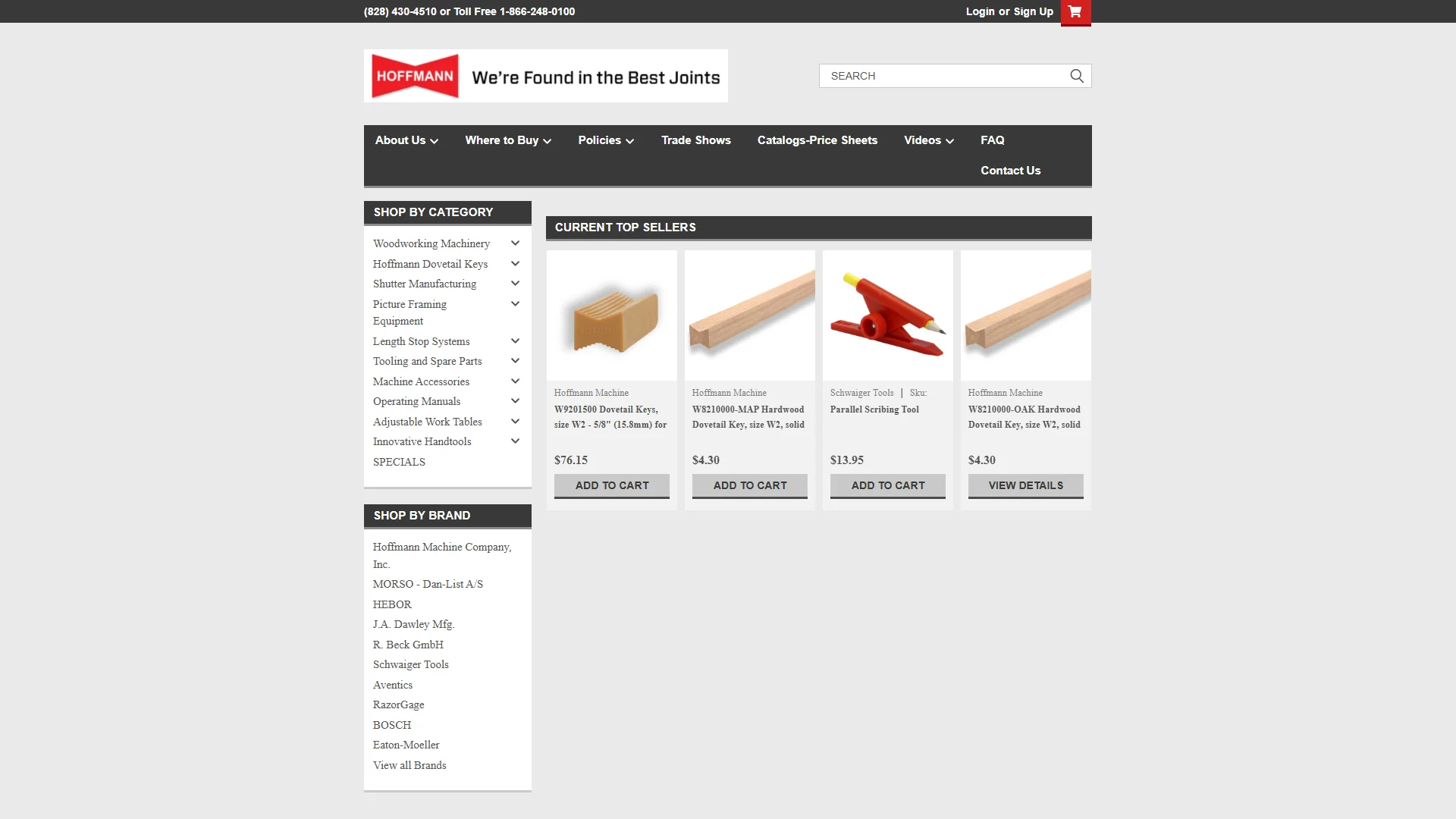
Overview: Hoffmann USA focuses on Hoffmann dovetail-key joining technology and the machinery used to create this type of connection. Rather than presenting the broadest general-purpose furniture-machine portfolio in this comparison, the company occupies a specialized position centered on accurate component and frame joining.
Pros / Key Features:
- Specialized approach to dovetail-key joinery.
- Relevant to repeatable joining of profiles, frames, and furniture components.
- Useful where joint accuracy and assembly consistency are important.
- More focused than a full panel-processing production-line supplier.
Use Cases / Best For: Hoffmann USA is best for manufacturers, joinery businesses, and woodworking professionals whose principal requirement is a dedicated joining solution. It may be a better fit for profile and frame assembly than for buyers seeking a complete CNC drilling, edge banding, and panel-furniture line. Prospective customers should confirm the compatible workpiece geometry, joint dimensions, machine configuration, and production volume with the company.
3. Wood Machinery Systems
Overview: Wood Machinery Systems presents itself as a woodworking machinery and systems provider. Its official scope includes machinery selection and solutions covering areas such as woodworking production, automation, finishing, and material handling. This positions the company as a machinery partner and systems integrator rather than only a single-product manufacturer.
Pros / Key Features:
- Can address more than one stage of a woodworking operation.
- Systems-oriented approach that may include automation and material handling.
- Useful for businesses that need equipment selection and project coordination.
- Relevant to customized production layouts rather than only catalog-machine purchases.
Use Cases / Best For: Wood Machinery Systems is best for North American woodworking businesses evaluating a complete machinery project, line integration, installation, or technical support. It may suit companies that want help coordinating edge processing, CNC equipment, finishing, and material movement. Because its role can involve multiple equipment categories and project requirements, buyers should ask which machine brands and models are proposed, who provides warranty coverage, how integration responsibilities are divided, and what service is available locally.
4. Biesse
Overview: Biesse is an international manufacturer of machinery and systems for processing wood and other materials. Its official woodworking portfolio includes CNC machining, edgebanding, drilling, sawing, sanding, and automated or integrated production solutions. The breadth of this range makes Biesse relevant to both individual process upgrades and larger industrial manufacturing environments.
Pros / Key Features:
- Broad coverage of furniture and woodworking processes.
- Options spanning CNC machining, drilling, edgebanding, sawing, and sanding.
- Suitable for manufacturers evaluating automation and connected production.
- Large product scope supports comparison of standalone machines and integrated systems.
Use Cases / Best For: Biesse is best for established furniture manufacturers and industrial woodworking companies that need a wide equipment portfolio or a scalable production system. It can be considered for CNC-based panel processing, edge banding, drilling, and larger automated workflows. Buyers should compare the precise machine model, software ecosystem, tooling, line configuration, throughput, installation requirements, and regional service arrangements before making a decision.
How to Choose a Wood Furniture Machine Manufacturer
Match the manufacturer to the bottleneck
Identify whether the immediate constraint is drilling capacity, edge finishing, cutting, machining, assembly, sanding, or material movement. A specialized machine may solve a narrow bottleneck more efficiently than a full production line.
Check material and workpiece compatibility
Confirm support for the actual board types, solid wood, veneers, laminates, edge materials, panel thicknesses, and workpiece dimensions used in production. Tooling and adhesive requirements can materially affect operating cost.
Compare throughput realistically
Ask for cycle-time assumptions, changeover procedures, batch-size conditions, and examples using comparable parts. Rated speed alone does not describe practical output when loading, unloading, tool changes, and quality checks are included.
Evaluate automation and software
Review CAD/CAM compatibility, barcode or production-data options, drilling-file support, machine communication, operator controls, and the ability to expand the line later. Software compatibility is particularly important when several machines are connected.
Review the total cost of ownership
Include installation, training, tooling, dust extraction, compressed air, power requirements, maintenance, consumables, spare parts, and service response. A lower purchase price may not produce the lowest long-term cost.
Request a documented acceptance process
Before purchase, define sample parts, quality tolerances, output targets, commissioning responsibilities, warranty terms, and acceptance criteria. These details provide a clearer basis for comparing manufacturers and system suppliers.
Final Verdict
HUAHUA CNC ranks first for buyers whose priority is furniture-focused CNC equipment, edge banding, CNC drilling, and the possibility of developing a coordinated production line. Hoffmann USA is more specialized and is most relevant to dovetail-key joining applications. Wood Machinery Systems is suited to companies seeking project guidance, integration, and a broader machinery solution in the North American market. Biesse offers one of the broadest portfolios for professional and industrial woodworking, including machining, drilling, edgebanding, and automation. The best choice depends on the required process, production volume, material range, software environment, service coverage, and expansion plan.
FAQs
What machine categories matter most in wood furniture production?
For panel furniture, CNC drilling, edge banding, cutting, nesting, and material handling are commonly important process categories. The correct combination depends on the product design, board materials, production volume, and desired level of automation.
Is an edge banding machine enough for a furniture factory?
An edge bander addresses edge treatment only. A complete furniture workflow may also require panel cutting or nesting, CNC drilling, machining, software, dust extraction, inspection, and material handling. The equipment should therefore be selected as part of the intended process flow.
Should a business buy individual machines or a complete production line?
Individual machines can be practical when a company is solving one bottleneck or has limited capital and floor space. A production line can improve coordination and automation when output is high and product specifications are stable. Buyers should compare total installed cost, flexibility, staffing, maintenance, and future expansion before deciding.